Women
Mary Beth Norton
believes that although the revolution did not liberate women, it opened the
door to significant changes for them, both immediately and in the long term:
"The re-evaluation of domesticity that began during the revolutionary
years would eventually culminate in the nineteenth-century culture's
glorification of woman's household role"
Women,
she claims, were no longer content to be 'good wives' and ignorant of the
larger world
Professor Joan Hoff
Wilson contends that the revolution diminished women's power ad place, while
enhancing men's: "The revolutionary generation of females were less
prepared than most men for the modern implications of independence"
Harry M Ward
believes that the revolution did not alter the position that women held in
society, though identifying their control over property: "few changes that
occurred during the revolutionary era affected women's property status"
Gordon Wood
discusses the positive outcome of women following the revolutionary war,
insinuating that the new society was more equal in terms of gender rights:
"the revolution made Americans conscious of the claim for the equal rights
of women as never before". Wood additionally argues that the commercial
expansion of American allowed for women to attain greater financial freedom
which they would later build on with jobs outside the home: "the new newly
enhanced roles for wives"
"No new social
class came to power through the door of the American revolution" (Carl
Degler)
Zinn states the not
much changed in regards to the role of women in society
Common Man
Dan Lacy discusses
the issues that arose between the American people in terms of class "the
conflicts of low countrymen and frontiersman, of rich men and poor… these two
sets of conflict sometimes coincided and sometimes cut across each other"
Harry M Ward adopts
a similar viewpoint, discussing the differences in social class which was
widened by the revolution: "there was a widening gap between the
well-to-do and the rest of society"
American workers
became more class conscious. They had already learned the value of collective
action for their revolutionary war experience, beginning with the activities of
the Sons of Liberty"
Zinn discusses the
difference between the elite and the common: the lower class "saw
themselves under the rule of a political elite, win or lose against the
British"
Slaves
Gordon Wood strongly
suggests that immediately after the revolution, the slave
Trade was
effectively banned: the revolution "suddenly ad effectively ended the
social and intellectual environment that had allowed slavery to exist
everywhere for thousands of years without substantial questioning"
Harry Ward explains
the unjust treatment of the African
American slaves in terms of the Declatarion of Independence, which pronounced
all men as equal, and all Americans to the rights of 'life, liberty and the
pursuit of happiness': "if all persons were indeed endowed with natural
and fundamental liberty, race of itself could not justify human bondage"
Harry
Ward additionally displays the unjust attitude of the new American society and
its prejudice towards the African Americans: "blacks hearkened to the
message of independence, only to discover that liberty wasn't meant for
them"
Ira Berlin takes up
African-American experiences during the revolution to show that slaves did in
fact, achieve some significant advances: "the number of blacks enjoying
freedom swelled under the pressure of revolutionary change… Freedom, even within
the limited boundaries of white domination, enhanced black opportunities by
creating new needs and allowing blacks a chance to draw on the rapidly maturing
Afro-American culture to fulfil them"
Gordon Wood
discusses the negative treatment of African American slaves, however emphasizes
that many Americans became aware of their mistreatment towards the slaves:
"slavery was a national institution, and nearly every American leader knew
that its continued existence violated everything the revolution was about
Loyalists
Harry M Ward
portrays the negative way the loyalists were treated through explaining their
harsh handling by the patriotic Americans following the war: "legal
penalties covered all degrees of loyalism, from behaviour exhibiting
non-support for the American cause to treason, entailing punishment ranging
from reprimand to death" Ward additionally emphasizes the types of
punishment the loyalists received "confinement, exile, deprivation of
civil rights, confiscation of property and execution"
"the loyalists
became a mere floating refugee population" (Brogan)
Dan lacy discusses
the economic gain that occurred for the Americans through the loyalists, which
is viewed positively at a time of financial difficulty for the Americans:
"all told, more than two million five hundred thousand acres, including
some of the best land in the state, was taken from fifty nine loyalists who had
monopolised these thousands of square miles"
Howard Zinn
discusses the benefits to the new American society that occurred through
detriment to the loyalists: "the huge landholding of the loyalists had
been one of the great incentives to revolution"
"The
confiscation of loyalists property gave the states and citizens a financial
interest in persecuting loyalists" (Harry M Ward)
Cantwell empathises
with the loyalists who were treated harshly for their views "the way in
which the newly independent united states treated those who did not agree with
them, that is those who remain loyal to Britain, is an important indicator of the
extent to which they stayed true to the ideals of the revolution"
Native Indians
Thompson empathises
with the Indians who suffered under the ruling of the patriotic Americans,
discussing the treaties which were established with the Indians, however
highlighting the way they "naturally tended to favour congress often
formalising the surrender of large tracts to the US"
Richard Brown offers
a sympathetic approach: "Congress was never friendly to Native Americans,
and calculations of self-interest lay at the core of American policy"
alternatively providing a motive for the treaties that the Americans were establishing
with the Indians
Howard Zinn
additionally emphasizes the violence the Indians endured: "Now, with the
British out of the way, the Americans could begin the inexorable process of
pushing the Indians off their lands, killing them if they resisted"
Gary Nash discusses
the American intention, laying a foundation for the American's resistance to
Indians due to their desire for western land: "Facing a white society in
1783 that was heavily armed and obsessed with the vision of western lands, tribes
such as the Iroquois and Cherokee were forced to cede most of their land"
Declaration of Independence
"The political
objective of the revolution, Independence from British rule, was achieved after
one relatively short effort. 1776 had no sequel and needed non: the issue was
separation, and separation was accomplished" (Daniel J Boorstin)
"the charter of
national liberty" (Julian P Boyd)
"The
declaration announced the failure of reform by petition" Congress
therefore "had to restate the grievances for which redress had been sought
through national channels" not for any "light and transient causes" but because of "a
long train of abuses and usurpations" by the ruling government Americans
who were driven to revolution and independence (Gary Wills)
War of Independence
Brogan emphasizes
the importance of Washington during the revolutionary war. Although he was not
a great fighting general, though he was a "capable and aggressive
one" He "possessed various other qualities that made him, if not
unique among commanders , at any rate highly unusual."…" always at
his post" Brogan also creates a sense of sympathy for Washington through
highlighting the difficulties he experienced: "Again and again his army
dissolved about him because civilian authorities did not keep it paid, clothed,
fed, sheltered, armed or reinforced… it is much to their credit, as to
Washington's, that the army never melted away completely"
American victory at Trenton and Princeton
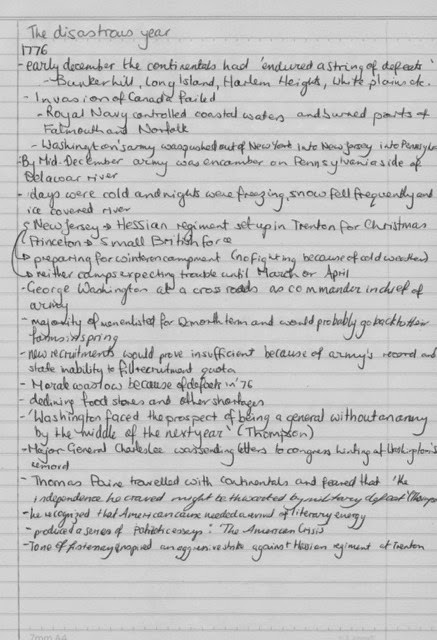
"… at Christmas
Washington turned, and in two lightening attacks across the Delaware River
defeated the royal forces at Trenton and Princeton… Strategic effect important.
They saved Pennsylvania for the time being and cleared most of New Jersey. Patriot
morale, which had been very low, made rapid recovery. Washington could live to
fight in the spring… He had won precious time and prestige for America: time
for an alliance to ripen, prestige to clinch it."
Search for allies
"Dr Franklin…
arrived in Paris 20th Dec 1776 to use his charm and scientific prestige to lure
Louis XVI and his minister into the war"
Brogan also says
that all Americans regardless of social statues experienced the war
"whether as a bloody struggle on their doorstep, or as a terrible
inflation which upset patterns of trade, or as a general scarcity of goods… or
most of all, as a revolution: an overturning of all the old political ways and
means"
Zinn: The revolution
has also been studied and interpreted by left-wing historians, both moderate
and radical. Focusing on class, economic conditions, race and gender, these
writers have explored the role ordinary people played in the unfolding
rebellion. Zinn observes the revolution as beginning as a series of responses,
aimed at harnessing popular anger and diverting it away from colonial
governments and towards the British. Zinn also likes this somewhat artificial
revolution to an act of theft, as colonial elites sought to "carve
off" part of the British empire for their own benefit.
Washington is not
presented as a hero advancing the cause of liberty but as a member of the elite
in whose interest the war was fought. Franklin is also viewed in this way. Zinn
argues that during the war much of the actual fighting was done by the poor who
suffered through the war unpaid, cold, dying of sickness, watching the civilian
profiteers get rich. Washington maintained tight discipline, using the lash,
and by suppressing mutinies as they occurred.
Articles of Confederation
Edward Countryman
praises the articles of Confederation as the first body of work produced by the
new American States, claiming that the articles "gave form to a ramshackle
structure that events had already thrown together". However in spite of
this, Countryman denounces the congress for lacking qualities of a national
government, classifying it more so as an '"alliance of sovereign
power"
Gordon Wood
emphasizes the creation of Congress, claiming that in the new society, it had
the power to exercise "an extraordinary degree of political, military and
economic power over Americans" therefore failing to recognise the role of
Congress under the articles of Confederation, which in fact left the new
national government with limited power.
Albert Bushnell Hart
is critical of the Articles, and argues that they failed to build a sense of
national unity or to provide central controls over trade, currency, credit or
banking: "on important questions, approval of nine states was necessary"
Richard Morris
maintains that the US suffered economically between 1783 and 1787, because
British trade policies sabotaged its post war recovery, while the states
behaved spontaneously and in their own self-interest, giving little regard to
national concerns. The articles of Confederation failed to provide the national
government with sufficient muscle to deal with these critical problems
Merrill Jensen poses
a different view, observing that they encountered opposition from the start,
and the federalists who desired trade and currency regulation pushed for the
states to grant Congress stronger imperial controls. When this failed, they began
to poison public perception of the articles, in the hope they would be
discarded: they "undertook to convince their countrymen of the
inadequacies of the Articles of Confederation" thus arguing that the
criticism of the articles was largely the work of fear-mongers and federalist
propagandists
THE CONSTITUTION
Howard Zinn-
“The inferior position of blacks, the
exclusion of Indians from the new society, the supremacy for the rich and
powerful in the new nation – all this was already settled in the colonies by
the time of the revolution. With the English out of the way, it could now be
put on paper, solidified, regularized, made legitimate, by the Constitution of
the United States, drafted at a convention of a Revolutionary Leaders in
Philadelphia. ”
P90” To many Americans over
the years, the constitution drawn up in 1787 has seemed a work of genius put
together by wise, humane men who created a legal framework for democracy and
equality. This view is stated, a bit extravagantly, by the Historian George
Bancroft (early 19th century). Bancroft argues that” The constitution establishes nothing that
interferes with equality and individuality. It knows nothing of difference by
descent, or opinions, of favored classes or legalized religion or the political
power of property …”
Early 20th century Charles Beard puts forward another view – studied the
economic backgrounds and political ideas of the 55 men who gathered in
Philadelphia in 1787 to draw up the constitution. Majority lawyers, majority
were men of wealth in land / slaves and property, half of them had money loaned
out on interest, and that 40 of the 55 held government bonds. Thus Beard argued
most of these men had direct economic interest in establishing a strong federal
government e.g. the moneylenders wanted to stop the use of paper money to pay off
debts, slave owners wanted federal security against runaway slave revolts, land
spectators wanted protection as they invaded Indian lands … Founding fathers represented the economic
interests they understood through personal experience.
Beard notes 4 groups were not
represented in the Constitution Convention: slaves, indentured servants, women,
men without property. And so the Constitution did not reflect the interests of
these groups.
Zinn
flaws the constitution of the states, suggesting that they were similar to the
previous conventions "The new constitutions that were drawn up in all
states from 1776 and 1780 were not much different from the old ones. Although
property qualifications for voting and holding office were lowered in some
instances, in Massachusetts they were increased. Only Pennsylvania abolished
them totally".
Zinn also
comments on the variation of social class in the new American society, by
stating that "The Constitution serves the interest of a wealthy elite- it
enables the elite to keep control with a minimum of coercion, a maximum of law
all made possible by the fanfare of patriotism"
Federalists and
Anti-Federalist
"The
Federalists were not men of the future after all… it was the anti-federalists
who really saw best and farthest. If either side in the conflict over the
Constitution stood for modernity, perhaps it was the Anti-Federalists. They,
and not the Federalists, may have been the real harbingers of the moral and
political world we know- the liberal, democratic, commercially advanced world
of individual pursuits of happiness" (Gordon Wood)
Henry Steele
Commager praises the Federalists, painting them in a positive light "The
Federalists… had the assets of youth, intelligence, something positive to offer
and, absolutely invaluable, the support of Washington and Franklin."
Commager additionally emphasizes the ideology of the Federalists, claiming that
they believed that "America needed integration, not state rights; that the
immediate peril was not tyranny but disorder or dissolution; that the right to
tax was essential to any government"
James Ely places
emphasis on the Federalists the outcome that the Federalists wanted to achieve
"ratification… would facilitate the restoration of credit and would
encourage commerce and manufacturing"
John Dilulio
portrays the anti-federalist in a negative way, claiming they were simply
"men united by narrow regional interests… by selfish economic interests…
or by [support] for slavery"
Gordon Wood
criticises the anti-federalists: "Tended to lack the influence and
education of the federalists, and often they had neither social nor
intellectual intellect"
Joseph Murphy
endorses the anti-federalists, praising their ability to relate to the ordinary
American citizens and the belief that the "republics were most likely to
succeed as small political entities where the government could consist of
delegates selected from the people, were well known by the people and
intimately knowledgeable of the wants and needs of the people"
Bill of Rights
Brogan: Bill of
Rights- would have been far fewer victories for the ordinary man and women
without the Bill, and at least since 1953 it has been the foundation for most of the solid
advances towards greater liberty which American society has made
Brogan: The
constitution as it emerged between 1787 and 1791 (including Bill of rights)
crowned the American Revolution and provided a safe compass for the future…
eliminated features of the old world which seemed obsolete/ unjust in new
world.
Zinn: The
constitution became even more acceptable to the public at large after the first
congress, responding to criticism, passed a series of amendment known as the
Bill of rights. Those amendments seemed to make the government a guardian of
people's liberties: to speak, to publish, to worship, to petition, to assemble…
It was therefore perfectly designed to build popular backing for the new
government.
Economic
The economic
depression can be linked back to the limitations of the articles of
Confederation. Thus, these issues were solved with the writing of the
Constitution. Hugh Brogan notes that the political framework established in
1787-91 contained enough of the old order to provide continuity, with enough
innovation to reflect the new world being created in North America: "The
constitution as it emerged between 1787 and 1791 crowned the American
Revolution and provided a safe compass for the future"
Charles Beard's analysis of the American
Revolution is concerned with the economic aspects of American society at the
time: "Large and important groups of economic interests were adversely
affected by the system of government under the Articles of Confederation-
namely those of public securities, shipping and manufacturing, money at
interest- in short capital, as opposed to land"
Shays' rebellion
Richard D. Brown: To
the elite, mob violence was threatening towards social order and political
autonomy, therefore provoking a need for the central government to be
strengthened and improve economic conditions in order to deal with potential
unrest like Shays' rebellion. Thus, it was deemed that the articles of
Confederation be altered: "In the midst of this turmoil, the U.S Congress
under the articles of Confederation could offer no remedies… it was this
realization-the sense that the national interest was failing and that a
vigorous national government could reverse the direction of American
politics-that led nationalists… to press for constitutional reform"
"Shay's
rebellion gave impetus to strengthen the national government" (Thompson)
The people noticed
that if there was another rebellion, it may not be able to put down as easily-
"nowhere in America was there sufficient force to defeat another such
challenge" (Brogan)
George Washington
Brogan emphasizes
the importance of Washington during the revolutionary war. Although he was not
a great fighting general, though he was a "capable and aggressive
one" He "possessed various other qualities that made him, if not
unique among commanders , at any rate highly unusual."…" always at
his post" Brogan also creates a sense of sympathy for Washington through
highlighting the difficulties he experienced: "Again and again his army
dissolved about him because civilian authorities did not keep it paid, clothed,
fed, sheltered, armed or reinforced… it is much to their credit, as to
Washington's, that the army never melted away completely"
Washington is not
presented as a hero advancing the cause of liberty but as a member of the elite
in whose interest the war was fought. Franklin is also viewed in this way. Zinn
argues that during the war much of the actual fighting was done by the poor who
suffered through the war unpaid, cold, dying of sickness, watching the civilian
profiteers get rich. Washington maintained tight discipline, using the lash,
and by suppressing mutinies as they occurred.
Benjamin Franklin
"Dr Franklin…
arrived in Paris 20th December 1776 to use his charm and scientific prestige to
lure Louis XVI and his minister into the war" (Brogan)
"No one in eighteenth-century American
assumed more personas and played more role than he" (Gordon Wood)
"He worked hard
to reconcile the colonies and the mother country" (Robert M Crunden)
Thomas Jefferson
"no one
embodied American's democratic ideals and democratic hopes more than Thomas
Jefferson" (Gordon Wood)
"Jefferson
stood for the rights of individuals" (Gordon Wood)




.jpeg)


.jpeg)



 A regular diarist,
prolific writer and correspondent. Born in Massachusetts. A Harvard graduate
who became a successful Boston solicitor with Whig Sympathies. He defended the
British soldiers who shot the citizens in the Boston Massacre. By 1770 he had
become a prominent member of the Sons of Liberty. In his essays Novanglus (1774-5) he defended colonial
resistance and argued that the British Empire was, in reality, a league of
autonomous entities. During the war he was sent as a diplomatic representative
to the Dutch Republic and he had the responsibility for opening negotiations
with Britain. He was one of the three men who negotiated the treaty of Paris
and ended the war.
A regular diarist,
prolific writer and correspondent. Born in Massachusetts. A Harvard graduate
who became a successful Boston solicitor with Whig Sympathies. He defended the
British soldiers who shot the citizens in the Boston Massacre. By 1770 he had
become a prominent member of the Sons of Liberty. In his essays Novanglus (1774-5) he defended colonial
resistance and argued that the British Empire was, in reality, a league of
autonomous entities. During the war he was sent as a diplomatic representative
to the Dutch Republic and he had the responsibility for opening negotiations
with Britain. He was one of the three men who negotiated the treaty of Paris
and ended the war. A founder of the Sons
of Liberty and Committees of Correspondence, he played a key role in resistance
to British rule in New England. Graduated from Harvard with an established
prejudice against British authority. He became James Otis’s lieutenant in the
struggle against British authority. From 1770 he assumed more of a leadership
role in the colonial cause in Massachusetts and played a major part in the
organisation and execution of the Boston Massacre and the Tea Party. He was a
crucial propagandist with a constant stream of articles in the New England
press. He was a delegate to both Continental Congresses and played an important
role in the move to declare independence.
A founder of the Sons
of Liberty and Committees of Correspondence, he played a key role in resistance
to British rule in New England. Graduated from Harvard with an established
prejudice against British authority. He became James Otis’s lieutenant in the
struggle against British authority. From 1770 he assumed more of a leadership
role in the colonial cause in Massachusetts and played a major part in the
organisation and execution of the Boston Massacre and the Tea Party. He was a
crucial propagandist with a constant stream of articles in the New England
press. He was a delegate to both Continental Congresses and played an important
role in the move to declare independence.  Benjamin Edes (1732-1803)
 In 1764 he inherited
the largest fortune in Massachusetts on the death of his
In 1764 he inherited
the largest fortune in Massachusetts on the death of his The Loyal Nine


